|
Water Tracing Dye
Technical Data |
|
 |
Fluorescent dyes are unique, high
quality formulations preferred by most professionals for visual leak
detection.
With these dyes, you can test sewer lines for infiltration, locate sewer
lines, check lines for illegal connections, proving septic bypasses and
toilet leaks, check circulation through sludge beds and detect leaks in
a closed system.
These dyes come in a choice of three colors. |
| |
-
Dye tracing products are used in many analytical
applications.
-
The unique needs of our customers seem almost unlimited.
-
Some of the most common uses are:
|
-
Plumbing tracing
-
Flow mapping and rate of
flow studies
-
Power plant piping tracing
-
Pollution studies
-
Lake, river and pond
analysis
|
-
Storm and sewer drain
analysis
-
Retention time studies
-
Condenser ceil and tube
studies
-
Septic system analysis
-
Leak detection in many
fluid
carrying systems
|
|
How Fluorescent Dye
Tracing Products Work:
The "visual" aspect of dyes
refers to normal reflection of light as color. The "fluorescent" aspect
refers to special properties of some chemicals to absorb certain
wavelengths and then emit, rather than reflect, light in response.
The emission can be seen by using a "black" ultraviolet light or
precisely measured with a fluorometer. The reflected and emitted light
have different wavelengths and are, therefore, not the same color. |
|
|
|
Fluorescent
properties are of greatest value when:
-
Tracing must be done when
there is no sun or sufficient artificial
light (in a sewer or a cave, for instance)
-
Precise quantified data is
required
-
Very small amounts of
tracing material is allowed
|
|
The maximum absorbance/emission wavelengths of our products are : |
|
Product |
Absorption |
Emission |
| Fluorescent Red |
550 nm |
588 nm |
| Fluorescent
Yellow / Green |
490 nm |
520 nm |
| Clear |
349 nm |
430 nm |
| Blue |
630 nm |
na |
Normally, the blue products are for visual tracing only. |
|
|
|
What PPB means? Most of our products
contain fluorescent dyes, which can be detected visually, or with the
use of ultraviolet light or fluorometer.
"PPB" refers to one part of active
dye per billion parts of water. Using a fluorometer, the active dye can
often be detected at levels less than one ppb. All data is presented as
reference points only and should not be regarded as a recommendation.
Users should make their own determination of
appropriate dilution levels in any specific situation, which will vary with
the nature, condition, and use of the water or liquid and the specific
evaluation to be performed. |
|
|
How to calculate the size of a body of water :
One gallon of water occupies .1337 cubic feet. For a rectangular tank,
multiply depth in feet times width times length divided by the factor
.1337 to establish the number of gallons. For more complicated bodies of
water, formulas can be found in scientific texts on water utility
management, hydrology etc. |
| |
Other Information
|
|
For stream tracing and pollution detection
Introduce tracers into the water at the source or suspected source of
pollution. Allow sufficient time as calculated, to permit the dye tracer
to reach the effluent or recipient location. Take samples of water for
analysis. |
| |
|
Dye tablets May
be dropped or flushed directly into drains, sewers or other points in
the system. However, it may be desirable to dissolve them in a small
amount of water to form a calculated concentration prior to use.
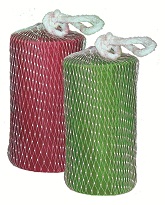
Special larger shapes (cakes, cones,
and donuts) have been designed to provide optimum dissolution rates in
larger systems. Donuts are frequently suspended from a line or string into
the body of water. Cakes and donuts are sealed in a handy water-soluble film
for ease of use. |
| |
|
Light stability
Blue has the highest degree of light stability and red is recommended
for yellow and green backgrounds such as algae rich water. Fluorescent
Red, Blue and Fluorescent Yellow/Green should be used in water bearing
heavy sediment loads or when passing through soil with high day content.
Photo degradation takes place in
sunlight at different rates for different dyes. Red takes from approximately
five to seven days and yellow/green fades in two to three days. Blue, on the
other hand, breaks down in three to four weeks.
The color of all dyes will disappear if the solution
is mixed with chlorine. Add approximately 4 grams of 12% bleach to every
gram of product in solution. |
| |
Examples of Specific
Projects
- Test sewer lines for infiltration
- Locate sewer lines
- Check for illegal connections
- Prove septic bypasses
- Identify indirect cross-connections
- Check drain pipes, downspouts, and gutters
to assure drainage into proper channels
- Use in inspection service for certification
and re-inspection documentation
- Analyze travel times
- Toilet leak detection kits are frequently
used by plumbers and salespeople. Municipalities and utilities use
them as part of public relations and water conservation programs.
- Detect leaks in closed systems and cooling
systems of manufacturing plants
- Study infiltration and industrial water
piping systems
- Trace acid coming through cooling systems
- Check pump systems' flow, and preventative
maintenance programs
- Detect sewer leaks into ponds, lagoons and
reservoir lines
- Check circulation through sludge beds and
measure discharge flow from water tanks
- Illustrate the hydraulic characteristics of
streams and other water bodies
- Identify and differentiate batches of
slurry
- Measure the speed and longevity of material
passing through a system
|
|
To our best knowledge, the
information and recommendations contained herein are accurate and reliable.
However, this information and our recommendations are furnished without
warranty, representation, inducement, or license of kind, including but not
limited to the implied warranties and fitness for a particular use or
purpose. Customers are encouraged to conduct their own tests and read the
material safety data sheets carefully before using these products. |
|
Go to Water Tracing Dye Index |